Headquartered in Forlì, Italy, Brighi Group (Brighi Tecnologie Italia Srl) has spent over five decades advancing textile automation—designing machines and modular production lines for pillows, cushions, quilts, and foam products.
Brighi Group (Brighi Tecnologie Italia Srl) combines modular machine design and Industry 4.0 software to modernize home textile production. Headquartered in Forlì, Italy, the company has designed and manufactured automation equipment for the bedding, upholstery, and polyurethane foam sectors since 1970, evolving from single sewing machines to fully integrated production lines.
For manufacturers in the textile industry evaluating automation and production upgrades for pillows, cushions, quilts, or foam products, Brighi's modular approach and digital ecosystem aim to deliver faster ramp-up, higher consistency, and measurable ROI—letting companies scale from individual machines to complete turnkey lines without replacing existing investments. See Brighi production lines to compare configurations and throughput estimates.
Brighi Group’s story begins in the 1960s, when Antonio Brighi operated a small sewing machine repair workshop serving the apparel and home textiles sectors. That hands-on work with sewing machines gave him deep technical insight into machine structure and failure modes—knowledge that later informed Brighi’s move into equipment design and manufacturing.
1970 marked a turning point. Brighi introduced the G164 industrial sewing machine, engineered for upholstered furniture and able to close cushions edge-to-edge without glue. Compared with the adhesive-based closures common at the time, the G164’s stitching method improved product durability and finish while avoiding glue-related health and environmental issues—an early example of applying manufacturing innovation to raise textile product quality.
International expansion followed over subsequent decades. In 1985, Brighi exhibited at Interzum (Cologne), opening channels into Europe and, later, North American and Asian markets. The company steadily built a global sales and service network to support growing exports of machines and systems.
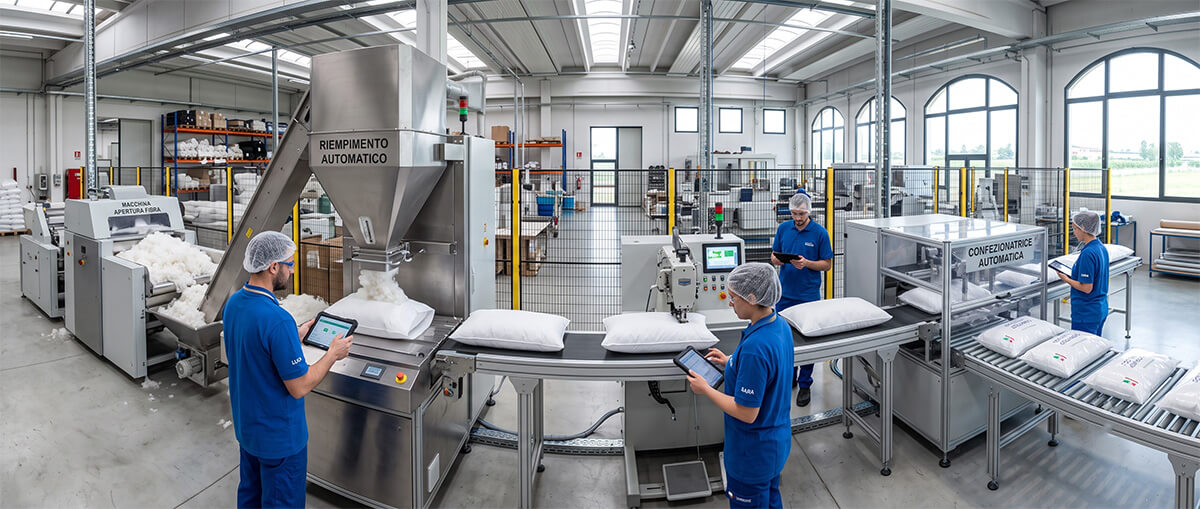
Another milestone came in 2003, when Brighi launched its first complete, fully automatic pillow production line—an integrated system that combined raw material handling, weighing and filling, sewing and closing, and finished-product packaging. That line was an important step in the company’s evolution and was the first Brighi complete line placed on the U.S. market, helping establish Brighi’s foothold in North America.
Strategic diversification continued with the 2015 acquisition of MECC, which added foam-making machinery to Brighi’s portfolio and enabled the company to serve mattress and raw-foam production customers as well as filled textile manufacturers—creating a more vertically integrated offering.
Responding to sustained U.S. demand, Brighi opened a U.S. subsidiary and warehouse in Houston, Texas, and later established a technical center in Thomson, Georgia, in 2018, providing local spare parts, technical assistance, and faster on-site support for manufacturers in North America.
Across these phases—from sewing machines to modular automation lines and foam equipment—Brighi evolved into a company that combines decades of sewing and textile manufacturing know-how with modern automation and software-driven production management. (For milestone sources and press releases, include links to company archives and product history pages where available.)
Brighi Group’s product strategy is built on one clear principle: modularity. Manufacturers can begin with a single machine and incrementally scale into fully integrated production lines as demand grows—preserving capital, shortening time-to-market, and enabling phased adoption of automation and Industry 4.0 technologies.
The table below summarizes representative models (Model = equipment identifier; Function = primary process served; Automation Level = typical operating mode). Each machine family targets specific production and quality needs across the home textile value chain.
| Model | Function | Automation Level |
| MAC-300 / MAC-400 / MAC-600 | Pillow pre-weighing and filling (3, 4, and 6 weighing units, respectively) | Fully automatic |
| EBL-500 EASY BLOW | Blown pillow pre-weighing, filling, and sewing in one machine | Fully automatic |
| EB-500 EASY BAG | Pillow flat packaging | Fully automatic |
| ER-500 EASY ROLL | Pillow rolling and packaging | Fully automatic |
| EB-400 EASY BAG | Pillow flat packaging | Semi-automatic |
| ER-400 EASY ROLL | Pillow rolling and packaging | Semi-automatic |
| SF-200 | Foam scraps shredding | Fully automatic |
| SF-300 | Fabric and fiber waste opening | Fully automatic |
| FA-400 | Rebonded foam block making | Fully automatic |
| FP-400 | Single-block foam production | Fully automatic |
| EP-400 EASY PILLOW | Semi-automatic stuffing and sewing | Semi-automatic |
| G164C | Closing the sewing machine for cushions | Manual operation |
| HF-100 | Semi-automatic stuffing and packaging | Semi-automatic |
| LF-100 | Semi-automatic compressing and sealing | Semi-automatic |
| MP-200 | Automatic cushion stacking | Fully automatic |
| MX-500 | Raw material mixing | Fully automatic |
These machines address five core process domains: filling, sewing, packaging, raw material processing, and waste recycling. The MAC and EASY series are central to pillow and cushion manufacturing—optimizing filling precision, sewing consistency, and packaging throughput—while SF, FP and FA families enable foam and recycling workflows for integrated production.
Key product-family strengths (summary):
For manufacturers seeking end-to-end automation, Brighi supplies complete production lines configured to product type and throughput targets. Typical configurations include:
Example business impact (illustrative—confirm with datasheets): a mid-size blown-pillow line using MAC and EASY modules can boost throughput by 30–60% versus manual filling, reduce material giveaways through precise weighing, and shorten changeover time using electronic recipe control.
To transform hardware into smart production systems, Brighi established Brighi Digital and the Supreme Automation Intelligence platform—a three-tier software stack that closes the loop between machines and enterprise management:
This architecture enables tighter systems integration, higher process control and accuracy, and ongoing optimization through data: operators use Domino to load machine recipes, engineers use Cerebro to prioritize production and schedule maintenance, and managers use Callisto to track output, quality, and efficiency across production lines.
Recommended next steps for editors: link each machine row to its product page or datasheet, and (where available) add short capacity ranges (units/hour), power requirements, and footprint to improve buyer decision-making and SEO relevance.
Brighi Group’s operational philosophy centers on three practical pillars that guide how the company designs, delivers, and supports automation systems for the textile industry.
Knowledge and Expertise. Every project begins with a technical assessment of floor space, throughput targets, and regulatory constraints. Brighi’s engineering team validates customers’ actual products on-site or in trial setups to ensure machine compatibility before configuration. The company invests continuously in R&D to offer tailored solutions—adapting existing machines or developing new modules when required—so manufacturers benefit from both proven platforms and targeted innovations.
Operations and Support. Brighi provides multi-regional support (Italy and the U.S.) with remote diagnostic capabilities via the Brighi Digital platform and local spare-parts supply from its technical centers. Support includes operator training during installation, documented commissioning procedures, and a choice of maintenance plans—periodic, preventive, and predictive—designed to minimize downtime and preserve production quality. Typical customer benefits: faster ramp-up, predictable uptime, and simplified spare-parts management.
Smart Solutions. Brighi’s software-first approach turns machines into data sources that drive operational improvement. By tracking KPIs and production metrics in real time, the system identifies bottlenecks, optimizes job sequencing, and prioritizes maintenance based on operating data rather than fixed calendars—improving efficiency and product consistency across production lines.
Mission and Vision. Brighi’s mission is to design and manufacture efficient, reliable automation systems that simplify manufacturers’ workflows by combining technology, research, and practical engineering. Its vision is to be the trusted partner for innovation in bedding and home textile automation—helping textile companies scale production with higher quality and lower per-unit labor content.
What customers get (quick checklist):
Recommended CTA (editorial placement): add a “Request a technical assessment” or “Schedule a demo” link here to convert interested manufacturers into qualified leads.
Brighi Group operates from two primary bases that combine Italian manufacturing with localized North American service:
Brighi’s machines and production systems have been exported across Europe, North America, and Asia, supplying textile companies and manufacturing sites with pillow, cushion, and foam production equipment. The company is a member of Europur (European Association of Flexible Polyurethane Foam Block Manufacturers), a recognized industry body whose membership supports credibility for Brighi’s foam-production technologies.
Brighi also maintains a regular presence at major industry events to showcase innovations, meet customers, and gather market feedback:
This trade-fair program supports product development and helps Brighi stay aligned with customer needs and fabric market trends. For manufacturers seeking local support or machine demonstrations, contact Brighi’s regional sales and service teams to arrange a visit or remote assessment.
From a technical standpoint, Brighi Group emphasizes several differentiators that matter to modern textile manufacturers aiming for higher precision, lower downtime, and tighter process integration.
Fully electronic recipe switching. Instead of time-consuming mechanical adjustments, Brighi machines use digital recipes that store parameters such as fill weight targets, sewing tensions, conveyor speeds, and packaging settings. Operators load a recipe at the touchscreen and the system automatically adjusts motors, servos, and actuator setpoints—enabling near one-click product changeover and reducing setup time and variability in multi-SKU, small- to medium-batch production.
Remote diagnostics and predictive maintenance. Brighi Digital collects machine operational metrics (cycle counts, motor currents, temperature trends, and runtime statistics) and makes that data available for trend analysis. Remote diagnostics let technicians identify anomalies and advise corrective actions; predictive maintenance routines use trending data to schedule interventions before failures occur—reducing unplanned stoppages and improving overall equipment availability.
Closed-loop waste recycling. Beyond filling and sewing equipment, Brighi supplies shredding, opening, and rebonding technologies that convert foam offcuts and textile waste into reusable filling material. This closed-loop approach reduces raw material purchases, supports circular production goals, and helps manufacturers meet ESG requirements without compromising product performance.
Practical clarifications and editor notes:
Brighi Group’s five-decade focus on home textile automation shows how specialization, modular machine design, and software-enabled production control can create durable global competitiveness. Decades of textile and sewing expertise, a product evolution from a single sewing machine to fully integrated production lines, and dual service bases in Italy and North America give manufacturers a partner able to support both initial automation and long-term scaling.
When evaluating automation investments, consider supplier depth (industry experience and R&D), the scalability of their production lines, and the responsiveness of after-sales service—factors that often matter more to long-term efficiency, product quality, and cost control than the upfront equipment price.
This article is based on publicly available company information published on the Brighi Group official website (www.brighigroup.com), with data current as of 2025.
The shift away from manual processes in developed markets—and the simultaneous need for reliable automation in emerging manufacturing hubs—makes modular, software-driven production lines a practical route to higher throughput, consistent fabric and product quality, and lower per-unit labor content. The 2003 fully automated pillow line and the 2015 MECC acquisition (foam-making capability) illustrate how Brighi has broadened its offering to serve vertically integrated production models.
Practical next steps: request verified datasheets and throughput ranges, schedule a plant-floor assessment, and consider a phased deployment (start with semi-automatic filling or packaging modules, then add upstream mixing or foam processing as volumes justify). Find product specs and contact details to begin technical comparisons and capacity planning.



Hello, I am the online customer service


